5 Things I've Learned About Cozy Mystery Writing From Save the Cat!
What does a screenwriting book have to do with cozy mysteries? More than I expected. Save the Cat! reshaped how I think about protagonist likability, exposition, and emotional stakes.
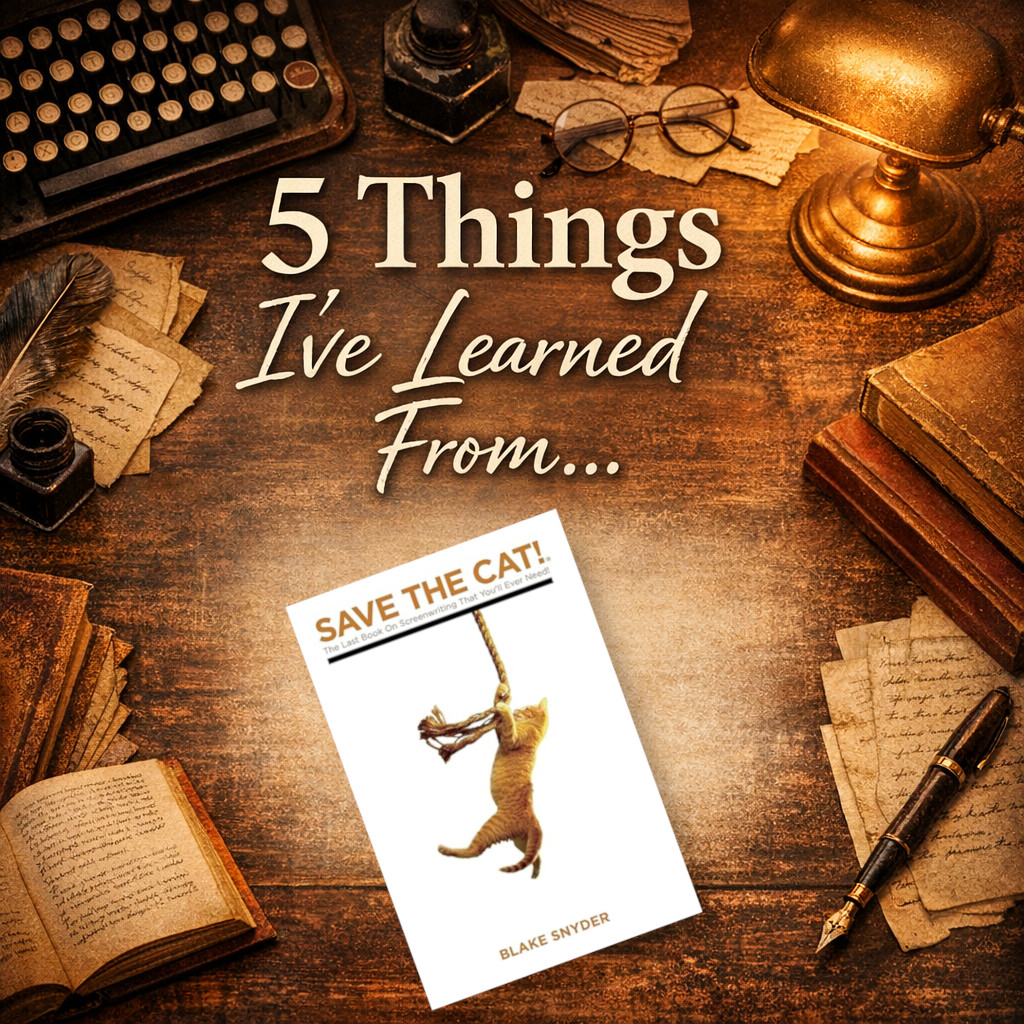
I finally caved and started listening to the audiobook of Save the Cat!
Let's be clear, I'm absolutely not planning to write a screenplay (I barely watch TV and movies, let alone dream of writing for them), but I needed something to keep me company while I powered through my day‑job tasks. I am also aware there's a novel writing version, but it's not on Hoopla, which is where I head for my audio-while-I-work sourcing.
I didn't expect it to hit me quite so hard as a novelist, but Blake Snyder's focus on audience engagement is surprisingly universal. Even for those of us who write about small towns, quirky neighbours, and the occasional dead body.
Here are the five biggest takeaways that made me rethink how I approach my cozy mysteries.
1. Your Protagonist Has to Earn the Reader's Vote
Snyder's famous "save the cat" moment, where the protagonist does something early on that makes the audience root for them, sounds obvious. But it's amazing how often we forget it. In cozies, the sleuth doesn't need to be perfect. In fact, she shouldn't be. But she does need to be someone readers want to spend 300 pages with.
What's interesting, at least in my opinion, is that some of the genre's icons don't have an obvious "save the cat" moment. Miss Marple in Murder at the Vicarage doesn't rescue anyone or perform a grand gesture. She simply observes from her cottage, cast on her foot, radiating a gentle, wry affection for her neighbours, even the dreadful ones. You like her because she sees people clearly and with grace.
Poirot is trickier. In The Mysterious Affair at Styles, he does rush to help without asking for compensation, which is admirable. But honestly, I think Hastings' narration does a lot of the heavy lifting in making Poirot's fastidious oddities charming rather than insufferable. This also may be why I'm not a fan of Poirot TV adaptations. They often fail to soften the weirdness of the character, relying on the audience's familiarity with the character to do the heavy lifting.
I don't have a single moment that makes my protagonist likeable, she just sort of oozes it by the way she treats her friends.
Takeaway: Give the reader a reason to like your protagonist, even if they're deeply flawed.
2. You Only Get One Big Ask
Snyder calls it Double Mumbo Jumbo: too many magical or unbelievable elements stacked together. You get one major suspension of disbelief per story. Use it wisely.
For me, this applies far beyond the paranormal, which I'm not a huge fan of unless it's baked into the premise. If your witch sleuth can can just do some woo woo every time you need her to have more information, I'm out. This, to me, explained why I've loved some paranormal mysteries, and others I just can't get through.
But the same principle applies to coincidences.
Sometimes the coincidences in stories are just laziness by the author. If I never read another mystery where the suspenseful climax only occurs because the protagonist either lost their phone or the battery ran dead, it'll still be too soon.
In my first Ellanore Finch book, I rely on one pretty big coincidence that feels organic to the social fabric of the town. Add another, and the whole thing would wobble. Add a third and the story would stink like that thing I once found in the back of my fridge that was too scary to open without a hazmat suit.
Takeaway: Cozy mysteries thrive on interconnected communities, but even small towns have limits.
3. Hide Your Exposition in Action
I am pushing my way through this one carefully as I begin drafting the second book in my series.
As series writers, we're constantly tempted to recap the previous book's events "just in case." But nothing kills momentum faster than two characters sitting at a café summarizing the last books' plot.
I once watched an episode of a soap opera while sick with COVID. I had watched the show occasionally as a teen, which was... let's just say a few years ago. Within ten minutes, I was fully caught up on the storyline thanks to a coffee‑shop exposition dump. It made me wonder why anyone would watch daily if once a week or month could fill you in on everything that mattered.
It makes even less sense in a book. You can't go back and watch last year's episodes of your favourite soap, or at least you couldn't before the age of streaming. (Somebody tell me, can you stream old seasons of soaps?) A book is likely always going to be available in one form or other for a curious reader.
If you tease rather than explain the previous books in the series, maybe a reader will pick up the earlier titles. If they already know everything that's happened, there's no point.
Takeaway: If readers need information from Book 1 while reading Book 2, they should get it through action, conflict, or discovery, not a recap disguised as dialogue.
4. The Protagonist Must Change
If your sleuth's life is perfect at the start, why tell the story at all?
The inciting incident, most often the murder, isn't just the start of the plot. It's the catalyst that shakes your protagonist out of a stagnant life. Without it, she'd stay stuck.
One of my favourite examples is The Unexpected Mrs. Pollifax. A bored, widowed woman in her sixties tells her doctor she's unhappy with her life. His advice? Take up something she's always wanted to do. Her dream? Become a spy. So she walks into the CIA and asks for a job.
Is it over the top? Absolutely. Does it work? Completely.
In my case, this particular nugget helped me understand how I needed to conclude the novel. The mystery was solved, the bad guy was caught, but I needed my protagonist to circle back to something that mirrored the very first scene of the book to show the trajectory of her growth.
Takeaway: The conflict should solve the protagonist's problem as much as she solves the mystery.
5. The Hero has to Lead
When I got to Chapter 7 of Save the Cat!, I had to stop doing my take-home-the-bacon work and start taking notes. I felt this chapter in my soul. Particularly the part about having the character stumble into clues rather than seek them out. And in seeking them out, my sleuth has to be following their guiding force or stated goals.
Rereading my manuscript, I did this somewhat, but I see how adding specificity to the goals of my sleuth, have her say them out loud, and make clear how her actions tie in to that goal, can make the book so much better.
When I added some dialogue between my sleuth and her friend, the eventual victim, that had the victim reassure the protagonist that she was going to find a path towards what she truly needed, suddenly every subsequent scene hit harder.
Takeaway: When revising your book, pay attention to how each event helps your sleuth progress towards, not just solving the case, but their primary goal as a character.
What About You?
If you've read Save the Cat!, or even if you haven't, what's the storytelling advice that's stuck with you the longest? Do you think cozy mysteries follow different rules, or do these principles still apply?